
On this Flashback Friday we go back to a post from September 6, 2014. At the time I visited this German war cemetery I never dreamed that three years later I would be living in Germany.
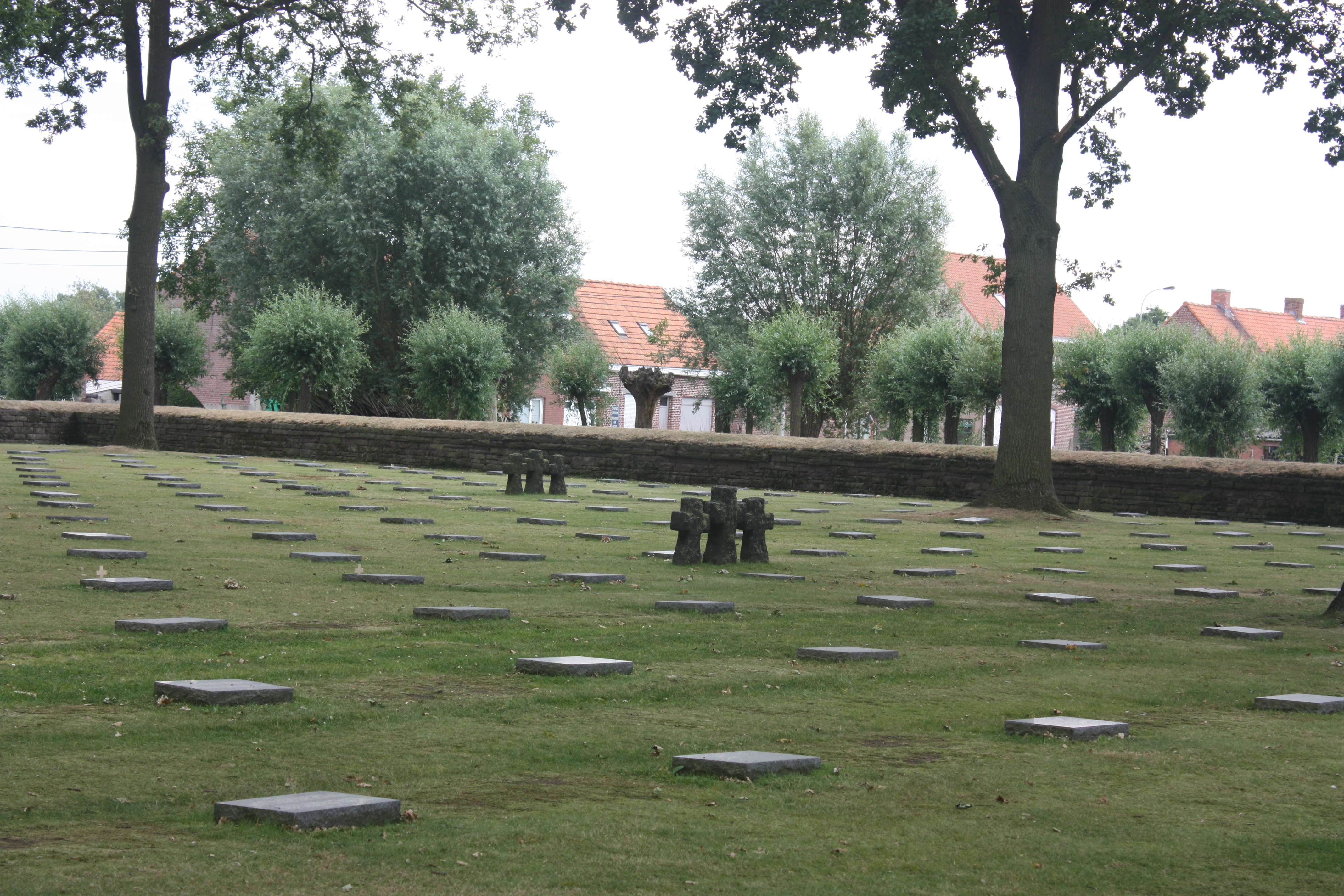
It is a solemn place and a stark reminder that there were no winners in the First World War. Langemark Cemetery is a memorial to young men who fought and died for a cause they believed in. But there are no rows of white headstones here. Instead the markers are black, set into the earth. The Commonwealth War Graves Commission does not tend these graves, as there are only two Allied soldiers buried here among the 44,000 dead. The brave young men who are beneath this earth were German.
The black stone markers are set in the ground, several names on each. They once were marked by crosses, but those wooden remembrances were used as firewood by the Belgians as German forces retreated during the Second World War. An understandable contempt maybe, but it would have been nice if they had bothered to keep records of whose graves were beneath those crosses before they burned them. My understanding was the grave markers today are more of a best guess than a record as to who is actually buried where. There is one mass grave which holds the remains of almost 25,000 soldiers, never individually identified. The numbers are a little mind boggling.
In Canada, the government supports the Commonwealth War Graves Commission. Each Canadian contributes through their taxes, though I suspect most are unaware of that. The German government, on the other hand, does not pay for the upkeep of the (fewer) war graves in Belgium and France. That is left to a private charity and the generosity of individual Germans.
These markers are indeed a reminder that the “enemy” was no older and no different than those fighting for the “good guys.” And indeed, here who is the enemy? As I have visited Commonwealth cemeteries I have looked for family names. Every cemetery has an Anderson or two, but it is an extremely common surname and these men are not related to me. I know I have relatives buried in Europe, my great-uncle Forrest Anderson, for example, was killed in 1918 and is buried in France at a cemetery I have never visited. There are other family surnames, but most of my relatives came home.
However there could be members of my wife’s family buried at Langemark. She is a first generation Canadian, and on the wall in the entryway, in the list of the 3,000 student-soldiers killed early in the war, I find carved one of the German family surnames. It is a possibility; we’ll have to ask her aunt, the family historian. It is only this year I discovered Vivian’s grandfather had been a solider in the First World War. I wondered at first whether my grandfather and hers had perhaps faced each other at some point in the trenches a century ago, but the only battle mentioned was Verdun, where I don’t think Canadian troops saw action. I don’t know exactly where my Grandfather fought, but one of these days I intend to look up his war record at the National Archives in Ottawa. He never spoke with me about his experiences, perhaps because of my age, and the only story my mother passed along was about Siberia (which will be subject of a future post I would imagine, once I finish these vacation reflections).
The visit to Langemark was also a reminder of how society can change in a short period of time. Many of the markers showed the religious affiliation of those buried there. A large number were Jewish. They served their country with pride and distinction. Their children would be rounded up, placed on trains and shipped to death camps where they would be exterminated by the successor of the government these soldiers served.
Postscript: Rereading this in 2024, I am still sobered by the ending. Times can change so quickly. I did download my grandfather’s service record from the Canadian archives, and discovered that the story my mother told didn’t actually take place in Siberia, though it was in Russia. I have reposted it several times over the past decade – it is a personal favorite. I don’t think I remembered to ask my wife’s aunt about Langemark, and now it is too late. Or maybe I did ask, and no-one from Vivian’s family was buried there.

 random thoughts from lorne